
Bill of Sale Aug 31, 2026
Michigan does not list a separate bill of sale as a standard requirement when the assigned certificate of title contains the buyer, seller, purchase price, date and mileage. The title is the main transfer document, but both parties should complete a separate bill of sale to preserve the price, condition, payment and handover terms.
The buyer has 15 days to transfer the title. A $15 late fee applies after that deadline. (Michigan)
Michigan Bill of Sale Quick Facts
Question | Michigan Rule |
Is a separate bill of sale normally required? | No |
Main ownership document | Properly assigned Michigan title |
Buyer’s title deadline | 15 days |
Late title fee | $15 |
Title transfer fee | $15 |
Private-sale tax | 6% |
Plate transfer | $10–$15 |
License plates | Removed and retained by seller |
Drive-home allowance | Three days on the most direct route with assigned title and insurance |
Seller’s record retention | Completed title copy for at least 18 months |
Online title transfer | Available for eligible transactions |
Standard inspection | No routine safety or emissions inspection listed for ordinary transfer |
These rules come from the Michigan Department of State and the Michigan Department of Treasury. (Michigan)
Is a Michigan Bill of Sale Required?
Michigan’s standard private-sale checklist requires the properly completed vehicle title rather than a separate bill of sale.
The title must show:
Buyer’s name, address and signature.
Seller’s information and signature.
Sale date.
Odometer reading.
Purchase price.
Lien termination, when applicable.
The VIN on the title must match the vehicle, and the ownership document should not contain unexplained alterations. (Michigan)
A separate bill of sale remains useful when the buyer later needs to prove the vehicle’s actual condition or a below-market purchase price.
What Documents Does the Buyer Need?
Document | Purpose |
Properly assigned original title | Transfers ownership |
Lien termination | Removes a satisfied loan |
Michigan No-Fault insurance | Required for registration |
Buyer’s identification | Confirms identity |
Payment for title and tax | Completes the transfer |
Plate transfer information | Used when moving an eligible plate |
Bill of sale | Supports price and condition evidence |
Michigan accepts several forms of lien termination, including a completed release on the title, a signed lienholder statement, a paid stamp, a company-letterhead release identifying the VIN, or a properly marked original finance contract. (Michigan)
Does a Michigan Bill of Sale Need to Be Notarized?
Michigan’s standard title-transfer instructions do not require the ordinary title assignment or supporting bill of sale to be notarized.
Both parties should complete the title accurately. If an error occurs, do not erase or alter the title without first checking the Michigan Secretary of State correction procedure.

What Taxes and Fees Apply?
Charge | Current Amount or Method |
Title transfer | $15 |
Plate transfer | $10–$15 |
Late title transfer | $15 |
Private-sale use tax | 6% |
New registration | Based on vehicle and plate |
Michigan No-Fault insurance | Required |
“You have 15 days to transfer the title after the date of the sale.”
— Michigan Department of State
The standard title transfer fee is $15, and a $15 late charge applies when the title is transferred more than 15 days after the sale. (Michigan)

How Is Michigan Private-Sale Tax Calculated?
Michigan imposes 6% use tax on a vehicle purchased from a person who is not a licensed Michigan dealer. The tax is paid during the Secretary of State title transaction. (Michigan)
The tax is not always limited to the amount written on the bill of sale. When the reported price is lower than the vehicle’s retail dollar value, Michigan may apply an additional equalization tax so that the combined tax equals 6% of the state-determined retail value. (Michigan)
A signed bill of sale that explains the vehicle’s condition, along with repair estimates or an appraisal, may help support a legitimate below-market value. The final valuation decision rests with the Michigan Department of Treasury. (Michigan)
What Happens to Michigan License Plates?
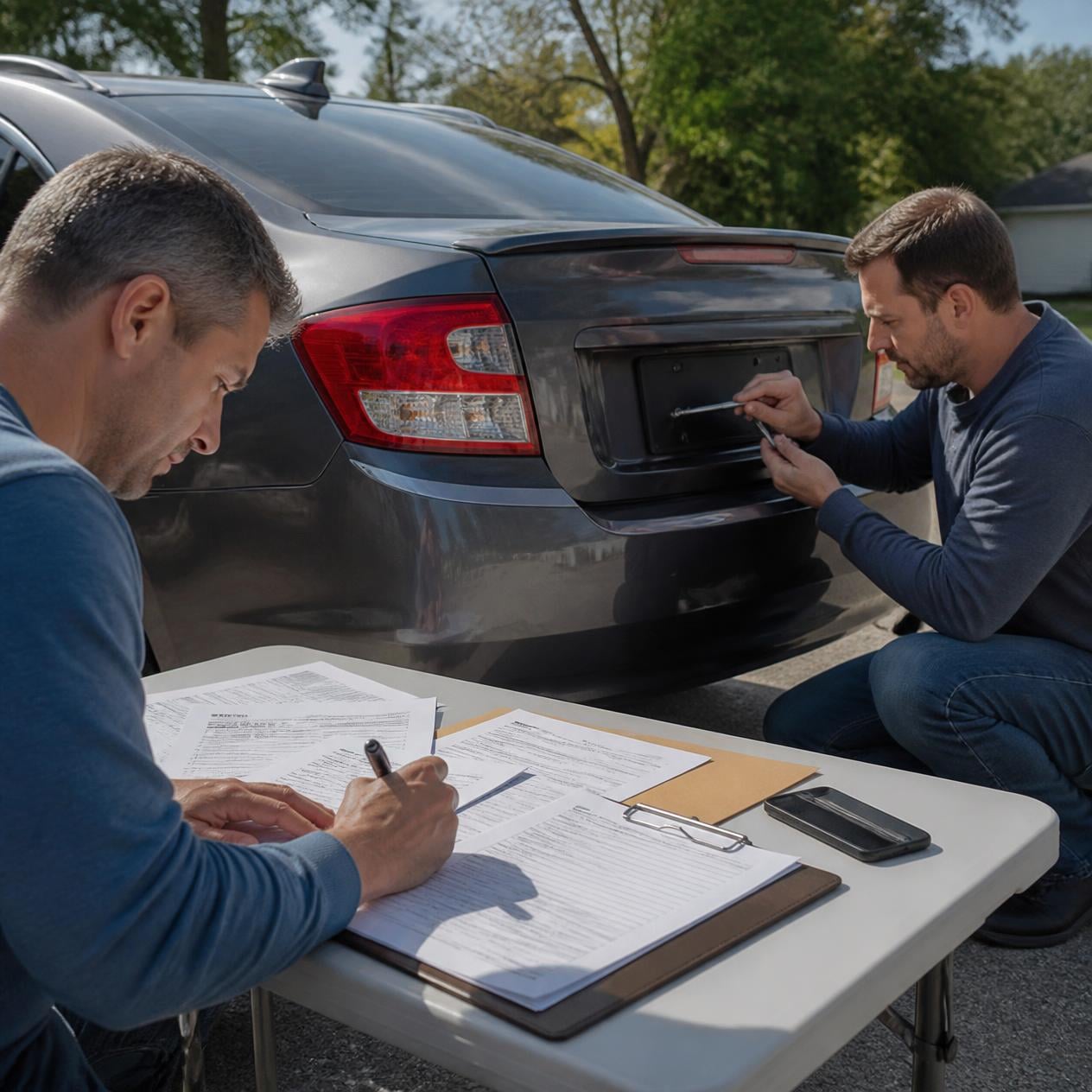
The seller must immediately remove and retain the plate.
“No. Immediately remove your plate when you sell the vehicle.”
— Michigan Department of State
The seller may transfer the plate to another eligible vehicle. The buyer must not borrow or use the seller’s plate. (Michigan)

Can the Buyer Drive the Vehicle Home Without a Plate?
Michigan allows the buyer to drive the vehicle home without a plate for up to three days when:
The buyer follows the most direct route.
The assigned title is carried in the vehicle.
Proof of insurance is carried.
The seller’s plate has been removed.
This limited permission is for taking the vehicle home. It is not a general three-day registration grace period for unrelated driving. (Michigan)
What Records Should the Michigan Seller Keep?
The title record remains in the seller’s name until the buyer submits the assigned title and completes the ownership transfer.
Michigan recommends that the seller:
Accompany the buyer to a Secretary of State office when possible.
Copy the front and back of the completed title.
Keep the copy for at least 18 months.
Preserve a signed bill of sale and payment record.
Remove the license plate immediately.
These records can help protect the seller if the buyer fails to transfer ownership or later uses the vehicle negligently. (Michigan)
Can the Title Transfer Be Completed Online?
Michigan offers online title transfer for eligible transactions.
General eligibility includes:
One individual seller and one individual buyer.
Valid Michigan driver licences or IDs.
Online service accounts for both parties.
A Michigan paper title.
An eligible passenger vehicle, motorcycle, pickup, van or SUV.
No buyer financing.
Successful completion of additional state eligibility checks.
The buyer pays the normal title, registration and tax charges online. (Michigan)
Transactions involving multiple owners, an electronic title, certain liens or special ownership circumstances may require an office visit.
Are Safety or Emissions Inspections Required?
Michigan’s standard private title-transfer checklist does not list a routine statewide safety or emissions inspection.
That does not replace the need for an independent mechanical inspection before purchase. Rebuilt, salvage or specially constructed vehicles can have separate inspection and documentation requirements.
How to Complete a Michigan Private Vehicle Sale
Confirm that the seller is named on the title.
Compare the VIN on the title with the vehicle.
Obtain a proper lien termination when needed.
Complete the buyer, seller, price, date and mileage sections.
Prepare a separate bill of sale for transaction records.
Remove the seller’s plate.
Have the buyer transfer the title within 15 days.
Gift and Family Transfers
Qualifying transfers between certain immediate family members may be exempt from Michigan use tax.
The Michigan Department of Treasury makes the final tax determination. The applicant may be required to document the relationship and prove entitlement to the exemption. Unsupported exemption claims can result in tax, penalties and other consequences. (Michigan)
Common Michigan Mistakes
Leaving the buyer section blank.
Missing the 15-day title deadline.
Allowing the buyer to use the seller’s plate.
Treating the three-day drive-home rule as unrestricted temporary registration.
Reporting an artificially low sale price.
Failing to obtain a lien termination.
Not retaining a copy of the completed title for 18 months.